Identify the charging gap you need to cover
A power bank for a day out should address a particular need. Perhaps only the phone providing navigation needs extra energy in the afternoon while the other is barely used. Perhaps both people take many photographs and want to charge their devices simultaneously during a longer break. Those routines require different connections and may justify different sizes.
Start with your existing devices, cables, and charging habits. A high capacity figure offers little value if the power bank is so heavy that it stays at home. Conversely, a particularly small unit may be unsuitable when several devices depend on it during the same trip. Use the manufacturer's usable-power and compatibility information rather than deriving a guaranteed number of full phone charges from the packaging.
The internal battery's capacity is not identical to the energy another device ultimately receives. Simply comparing two mAh figures is therefore not a reliable calculation of complete charges. Different voltage references and losses matter. An understandable manufacturer explanation is more useful for selection than an invented endurance promise.
Distinguish input from output
Check whether each port recharges the power bank, supplies another device, or supports both roles. The presence of a USB-C socket does not by itself establish how you can use it. The exact model's instructions and markings should explain this clearly. Identify which charger you intend to use for replenishing it at home too.
USB Power Delivery enables coordinated power provision between components designed to support it. The USB-IF describes the cooperation of suitable devices and cables. That does not mean every combination with the same connector shape achieves the highest advertised output. The phone, power bank, and cable each need the required capabilities.
For two devices, examine the output available during simultaneous use. A prominent maximum may apply to one port alone. Read the table for the particular port combination you expect to use. Two sockets indicate possible connections, not a promise that both deliver their individual maximum ratings together.
Make the connection fit your carrying arrangement
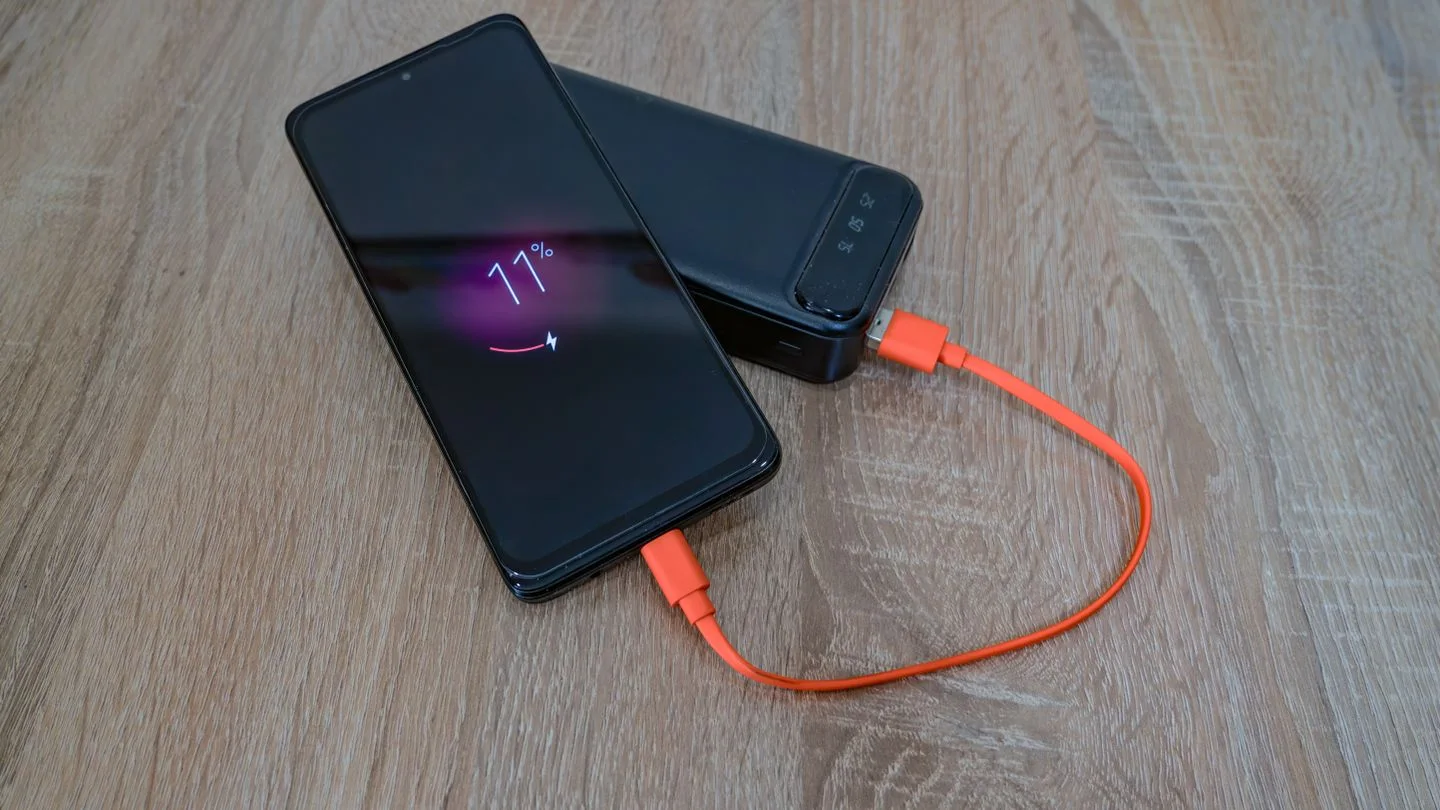
Put the power bank, phone, and cable beside one another. A very short cable may sit neatly on a table while becoming too taut between separate pockets. A long cable permits more separation but takes more space and can catch on other belongings. Choose its length around the intended charging arrangement rather than the smallest possible accessory bundle.
Check that the plugs fit with your phone cases and are not pushed sideways by their edges. Damaged cables or equipment should not form part of the travel arrangement. Follow the manufacturer's ventilation, temperature, and use instructions; a tightly closed luggage compartment is not automatically a suitable charging location.
A charge display helps only when both people understand it. A few illuminated dots and a percentage figure communicate the state differently. Your routine for checking the charge and assigning responsibility for replenishing it before departure matters more than a particularly elaborate display.
Air travel adds separate requirements
For a flight, technical compatibility with the phone is insufficient. Before packing, consult the operating airline's current power-bank rules covering energy limits, quantity, carrying position, and onboard use. Read the section specifically concerning power banks rather than only guidance for devices with built-in batteries.
Lufthansa separates those categories on its information page. It excludes power banks from checked luggage and specifies additional stowage and onboard-use conditions. This is one operator's example, not a permanently applicable summary of every airline. A connecting journey may involve more than one set of requirements.
Keep the model and energy markings legible. Watt-hours and watts answer different questions: stored energy is relevant to the transport check, whereas charging power addresses a separate buying decision. If a rating is unclear or approval is required, resolve that with the operator before travelling rather than first asking at the checkpoint.
Agree on a straightforward charging routine
Decide which phone is likely to need energy first and who carries the accessories. That avoids using most of a shared power bank for a low-priority task while the phone holding tickets runs low later. The agreement need not involve an elaborate percentage calculation.
Pack only compatible cables and try the intended combination at home according to the equipment instructions. A charging symbol confirms a connection, not necessarily the speed you expect. A suitable power bank combines energy, connections, and handling that match your routine, with any transport requirements checked beforehand.
Sources & current information
Opening hours, connections and conditions can change. Consult official sources before travelling and follow local notices.