Compare cups before litres
First gather the cups you intend to drink from. Two small servings after a city walk require a different quantity from several extended breaks. You do not need to choose around an abstract ideal capacity. What matters is the amount you actually want to fill and carry.
A large insulated flask occupies its full outer dimensions even when only partly filled. A smaller one may be easier to accommodate for the intended stop. Equally, check that it holds enough for both people and the number of breaks planned. One shared flask also concentrates the weight with its carrier.
Where will the second cup come from?
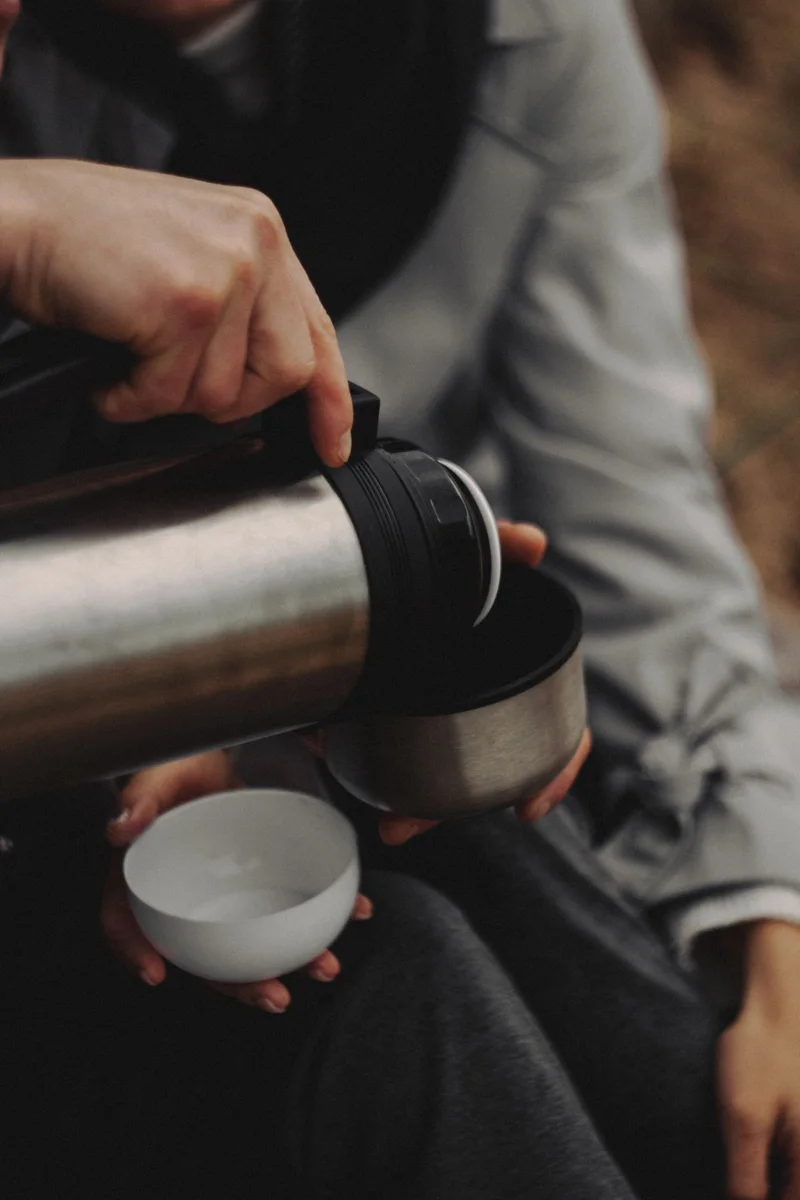
An outer lid that doubles as a cup does not automatically provide for two people drinking simultaneously. Decide whether you will bring another suitable cup or take turns. If you want a deliberately shared seated pause, resolve this small part of the routine beforehand.
Assess the lid as a drinking vessel separately from its fit on the flask. Is its shape convenient, and can it stand as you want? A broad base may be pleasant on a suitable table while occupying more bag space. The intended stopping place therefore influences the equipment too.
Learn the operating sequence as instructed, initially using cold water. How do you open the pourer and close it again? Can the outer cup be replaced without inadvertently twisting the inner closure? This familiarises you with handling; it does not reproduce a manufacturer's insulation test.
Temperature claims come with conditions
An advertised heat-retention duration concerns the conditions described by the manufacturer. Repeated opening and your particular fill quantity may create a different routine. Do not treat an hours figure as a promise covering every drink and every break.
THERMOS directs readers of its FAQ to individual products' Care and Use manuals. Guidance on preparing the flask also belongs to these model-specific instructions. Follow the information for the product actually purchased, including its beverage and filling restrictions.
For a day out, understandable handling is often more relevant than comparing maximum advertised times. Consider how you grip the flask while pouring and whether both people understand its closure.
Examine the cleaning arrangement before buying
Check which parts of the lid the instructions permit you to dismantle and whether matching replacement seals are available. A more elaborate pourer may be convenient to operate while requiring more care. That is a trade-off rather than a universal disadvantage.
Cleaning instructions for the steel body and lid can differ. Do not transfer a dishwasher statement to the complete product without checking. Allow space for the specified drying method too, rather than leaving the flask closed in its bag after returning.
Choose the smallest arrangement that fully supports your actual break: enough drink, two suitable ways to drink it, and a comprehensible closure. Additional cups and functions should have an identifiable role in that routine.
Sources & current information
Opening hours, connections and conditions can change. Consult official sources before travelling and follow local notices.